
Venomous Snake Identification: What Florida Dog Owners Should Know
Living in Florida means sharing the outdoors with many different types of wildlife, including snakes. Most Florida snakes are harmless, but a few species are venomous and can pose a serious risk to people and pets.
For dog owners, knowing how to recognize the venomous species found in Florida can help you make safer decisions when you’re walking your dog, spending time in the yard, or exploring outdoor areas.
Florida’s venomous snakes include the eastern diamondback rattlesnake, timber rattlesnake, pygmy rattlesnake, cottonmouth, copperhead, and coral snake. Some of these species have very limited ranges within the state. (Florida Museum)
Eastern Diamondback Rattlesnake
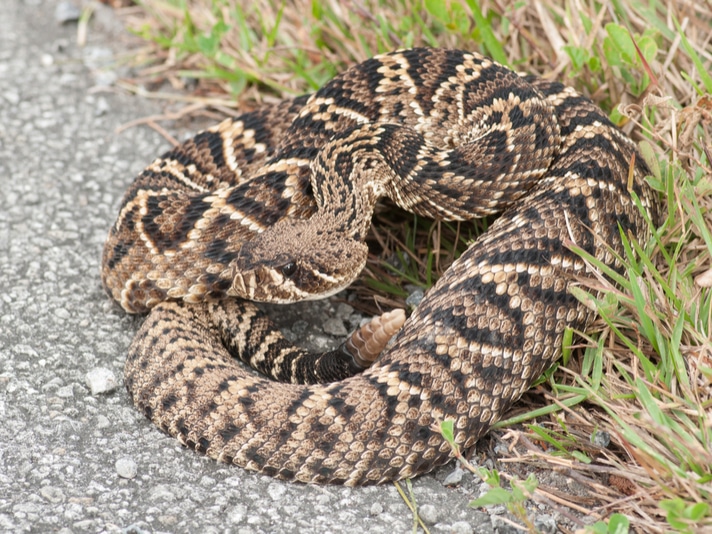
The eastern diamondback is the largest rattlesnake in Florida and is recognized by the distinctive dark diamond-shaped markings along its back. The diamonds are usually outlined with a lighter color.
It also has a rattle at the end of its tail. However, you should never rely on hearing a rattle before recognizing a snake as dangerous. A snake may not always produce an obvious warning sound.
Eastern diamondbacks can be found in a variety of habitats, including dry areas, wooded areas, and fields. (Ask IFAS – Powered by EDIS)
Pygmy Rattlesnake
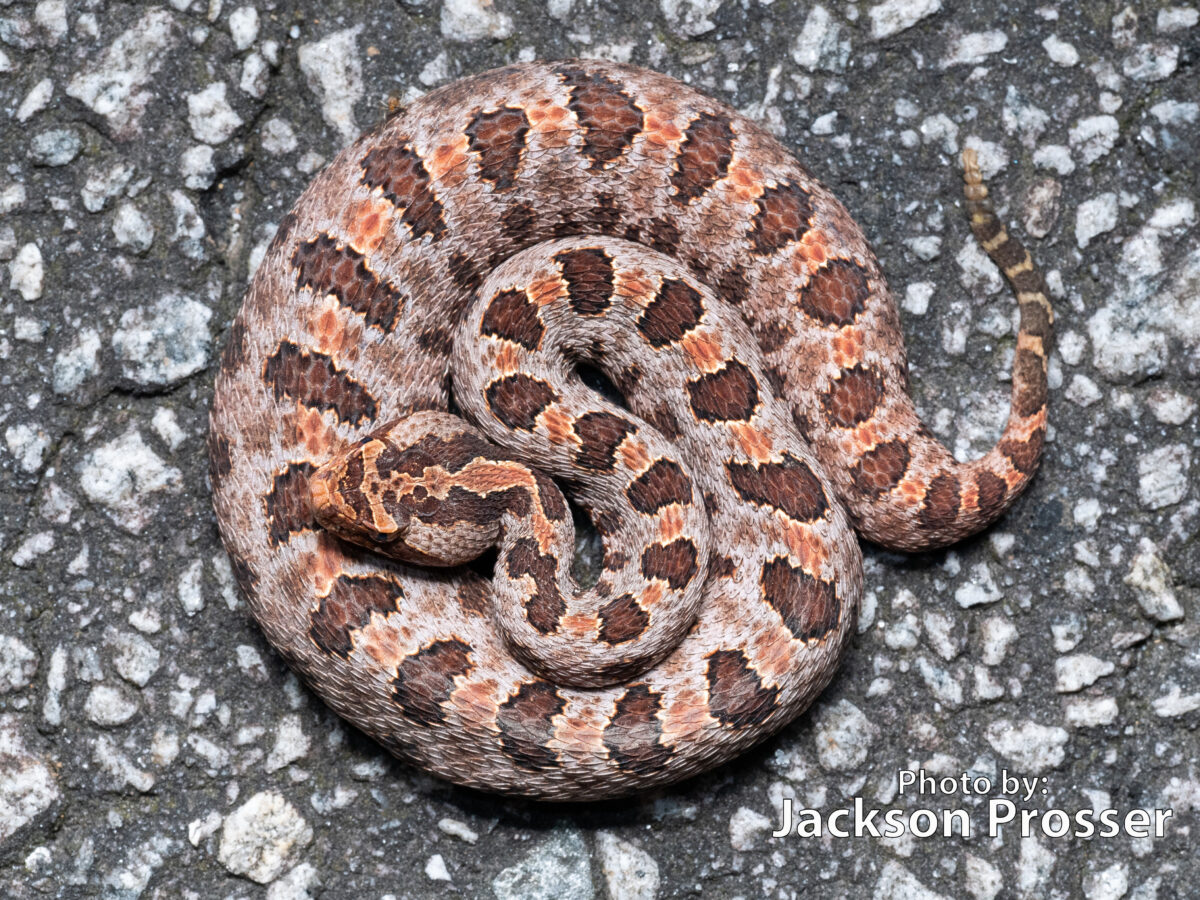
Pygmy rattlesnakes are much smaller than eastern diamondbacks, but their size does not make them harmless.
They have a gray or brown body with darker spots or blotches and a small rattle on the end of the tail. Their rattle can be difficult to hear and may sound more like a buzzing or insect-like noise.
Pygmy rattlesnakes can be encountered in areas such as gardens, brush, and other places where small prey is available. (Ask IFAS – Powered by EDIS)
(SREL)
Cottonmouth
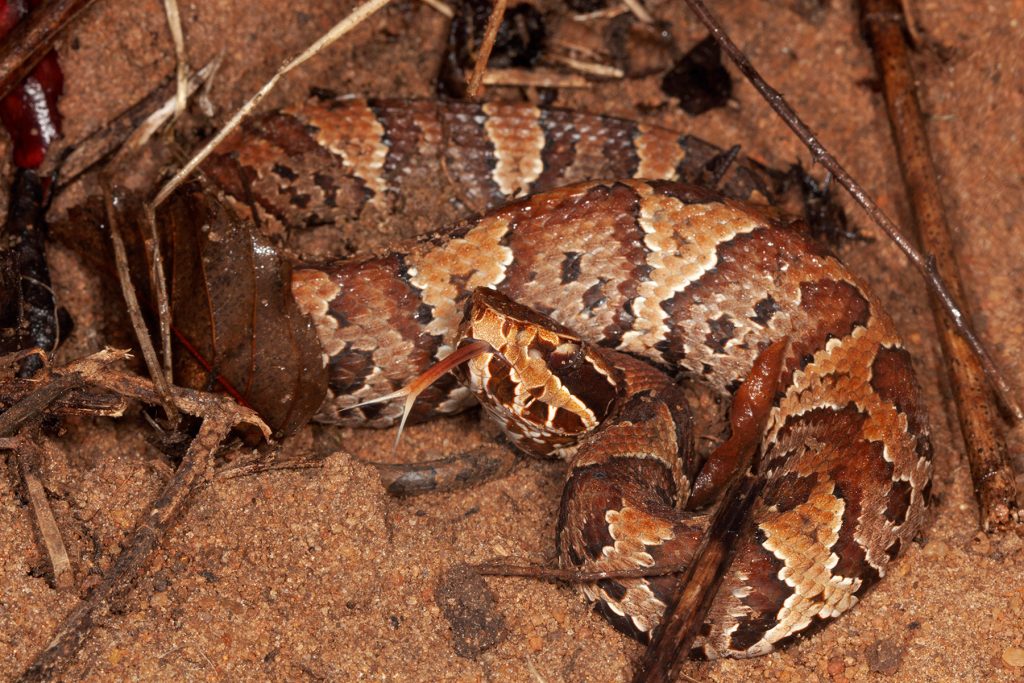
The cottonmouth, also called the water moccasin, is commonly associated with water. It can be found around ponds, lakes, rivers, wetlands, ditches, and other wet areas throughout Florida. (Florida Museum)
Adults can become very dark as they age, sometimes appearing almost completely black. Younger cottonmouths have more noticeable brown markings and may have a yellowish tail tip.
One well-known defensive behavior is opening its mouth when threatened, exposing the pale interior that gives the snake its common name.
Cottonmouths are venomous and their bites can be dangerous to dogs. They generally avoid people and pets, with many bites occurring when the snake is accidentally stepped on or deliberately approached. (Florida Museum)
Eastern Copperhead
Copperheads have brown hourglass-shaped markings across a lighter-colored body. They are relatively thick-bodied snakes and are well camouflaged in their natural surroundings.
For Florida dog owners, one important detail is their limited distribution. Copperheads are primarily found in the Panhandle, particularly around the western part of the state and the Apalachicola River area. They are not a common venomous snake throughout the rest of Florida. (Florida Museum)
Because young cottonmouths can resemble copperheads, location is an important part of identification.

Timber Rattlesnake
Timber rattlesnakes are another venomous species found in Florida, but their distribution is limited primarily to northern parts of the state.
They are larger-bodied rattlesnakes with a pattern that can vary considerably. Like other rattlesnakes, they have a rattle at the end of the tail.
Their limited Florida range means that location can again help narrow down what species you may have encountered. (Ask IFAS – Powered by EDIS)

Coral Snake
The eastern or harlequin coral snake looks very different from Florida’s pit vipers.
It is relatively small and slender, with smooth, shiny scales and rings of red, yellow, and black around its body. Its snout is black.
Coral snakes can be confused with harmless snakes that have similar colors. In Florida, one identification clue is that the coral snake has red bands touching yellow bands, while the common nonvenomous lookalikes have red bands touching black. (Ask IFAS – Powered by EDIS)
Because color patterns can be difficult to see clearly, especially from a distance, it is safest not to approach a snake simply to determine which species it is.

Don’t Rely on a Triangular Head
A common belief is that a triangular or arrow-shaped head means a snake is venomous.
That isn’t a reliable identification method.
Some harmless snakes flatten their heads when they feel threatened, making their heads appear wider and more triangular. Florida’s wildlife experts specifically caution against using head shape alone to determine whether a snake is venomous. (Ask IFAS – Powered by EDIS)
The same applies to other individual characteristics. Trying to get close enough to inspect a snake’s eyes, pupils, scales, or head can put you unnecessarily close to a potentially dangerous animal.
What Should You Do If Your Dog Finds a Snake?
The safest response is to create distance.
Don’t allow your dog to investigate, chase, corner, or bite the snake. Even a harmless snake may bite when it feels threatened, and trying to catch or kill a snake increases the chance of someone being bitten. (Ask IFAS – Powered by EDIS)
If possible, calmly move your dog away and keep them under control while giving the snake a clear path to leave.
This is one reason reliable obedience and recall are valuable outside the training environment. A dog that immediately responds when called is easier to move away from wildlife before an encounter becomes dangerous.
What If Your Dog Is Bitten?
If you believe your dog has been bitten by a venomous snake, treat it as an emergency and contact a veterinarian immediately.
Do not attempt to handle the snake to identify it. If it can be photographed safely from a distance, a photo may help with identification, but your dog’s safety comes first.
Venomous snake bites can cause serious medical problems, and treatment should be handled by veterinary professionals.
How Training Can Help
You cannot guarantee that your dog will never encounter a snake, but training can improve your ability to manage the situation.
Reliable recall, impulse control, and the ability to respond to the handler around distractions can help you interrupt your dog’s interest in wildlife.
Training should not involve intentionally exposing your dog to a venomous snake. Instead, build reliable responses in safe environments and gradually practice around appropriate distractions.
Final Thoughts
Florida is home to many snake species, and most are not dangerous to people or pets. Learning the basic appearance and distribution of the state’s venomous species can help dog owners recognize potential risks without unnecessarily harming harmless wildlife.
Most importantly, you don’t need to get close to a snake to identify it. If you’re unsure what species you’re looking at, keep your distance, move your dog away, and leave the snake alone.
For dog owners, good training can provide another layer of safety by giving you better control when your dog encounters wildlife, unfamiliar environments, and other distractions.
Website Contact Form
"*" indicates required fields